Documenting the journey of a startup.
Will include the process of Legal, Registration and Operations.
Tentative Company name : Tech Vistara
Mission Statement
At Tech Vistara, our vision is to revolutionize education by harnessing the transformative power of cutting-edge AI technologies. We aim to bridge the knowledge gap across India, empowering learners with advanced tools like Computer Vision, Deep Learning, and Diffusion Models to create engaging, immersive, and accessible educational experiences. By leveraging speech and animation technologies, we strive to make education universally impactful, fostering a future where knowledge knows no boundaries.
Progress
- Purchased the Domains on Hostinger
- Purchased two domains with .com and .in
- Domain Names : techvistara.com , techvistara.in
- Hosted a landing page using replit-ai and Azure web app : Tech Vistara
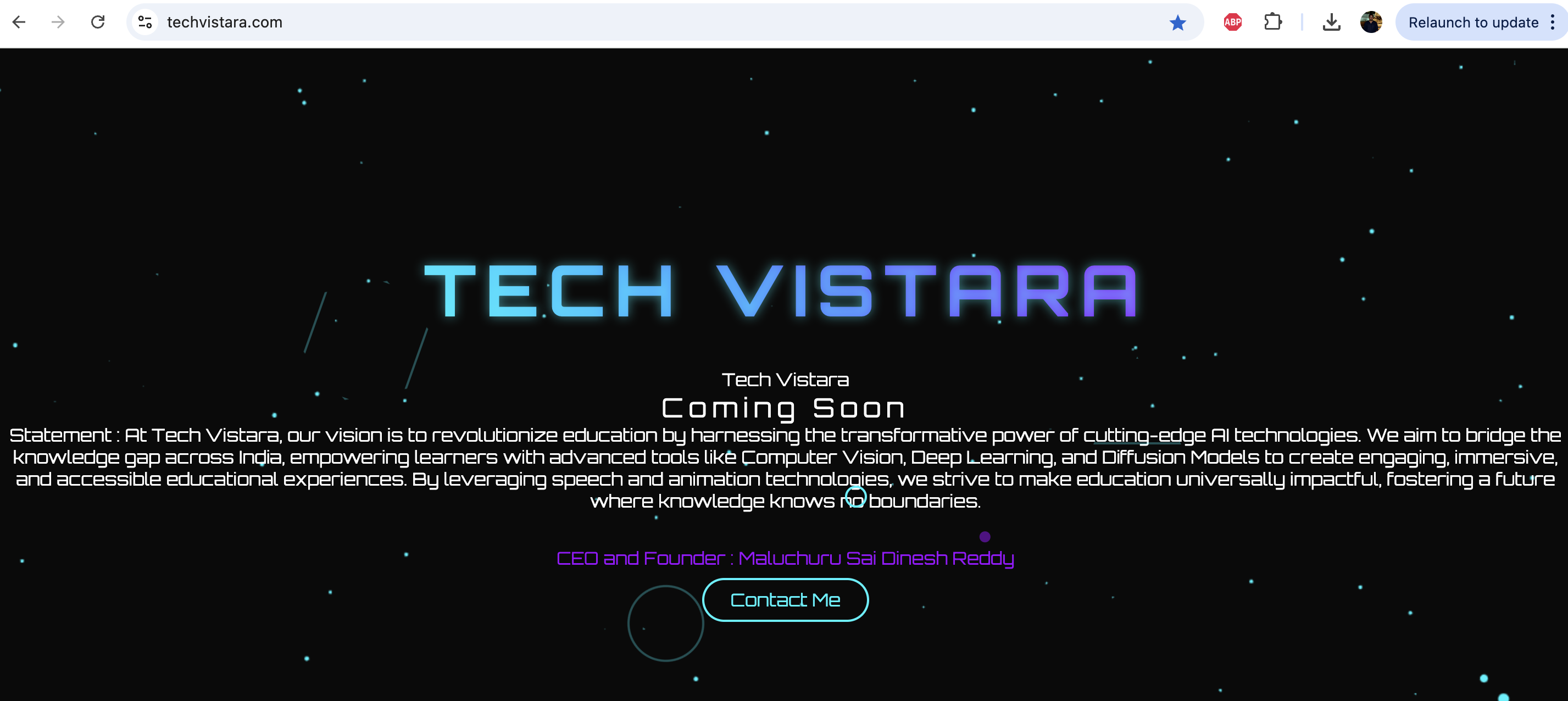
- Pointed the purchased domains in hostinger to the above webapp.
Company building in progress
Background & Prerequisites — What You Need to Know Before Writing This Blog
Starting a company in India involves navigating legal, financial, and operational requirements. Below is an in-depth breakdown of every topic you need to research and cover.
1. Types of Business Entities in India
Why: Choosing the right structure affects taxation, liability, fundraising ability, and compliance burden. - Sole Proprietorship — Simplest form. No separate legal entity. Owner has unlimited personal liability. Good for freelancing or small side projects. Registered via GST or MSME registration. - Partnership Firm — Two or more people. Governed by Indian Partnership Act, 1932. Partners have unlimited liability. Registered with Registrar of Firms (optional but recommended). - LLP (Limited Liability Partnership) — Hybrid: partnership flexibility + limited liability. Governed by LLP Act, 2008. Partners' personal assets are protected. Minimum 2 partners. Registered with MCA (Ministry of Corporate Affairs). Good for service companies and small teams. - Private Limited Company (Pvt Ltd) — Separate legal entity. Shareholders have limited liability. Can raise equity funding. Governed by Companies Act, 2013. Minimum 2 directors, 2 shareholders. Best for startups planning to raise investment. - One Person Company (OPC) — Single shareholder Pvt Ltd variant. Limited liability. Converts to Pvt Ltd if revenue exceeds ₹2 crore. - Section 8 Company — For non-profit purposes. No dividend distribution.
2. Company Registration Process (Private Limited)
Why: Most tech startups register as Pvt Ltd. You need to document the exact process. - Step 1: Obtain DSC (Digital Signature Certificate) — Required for all directors to sign electronic documents. Get from a Certifying Authority (e.g., eMudhra, Sify). Costs ₹500-1500, takes 1-2 days. - Step 2: Reserve company name — Via SPICe+ (Simplified Proforma for Incorporating Company Electronically) on the MCA portal. You can propose up to 2 names. Name must not be identical/similar to existing companies. Include "Private Limited" suffix. - Step 3: Draft MOA and AOA — Memorandum of Association (MOA): states the company's objectives, authorized share capital. Articles of Association (AOA): internal rules for governance. Templates available; customize for your business. - Step 4: File SPICe+ form — Single form that covers: name reservation, incorporation, DIN (Director Identification Number) allotment, PAN/TAN application, GST registration, EPFO/ESIC registration, bank account opening. Submit via MCA portal with required documents. - Step 5: Receive Certificate of Incorporation — Issued by Registrar of Companies (ROC) with CIN (Corporate Identity Number). Company is now a legal entity. - Documents needed — ID proof and address proof of directors, registered office address proof (rent agreement + NOC from landlord + utility bill), passport-size photos, MOA/AOA. - Timeline — 7-15 working days. Cost: ₹5,000-15,000 (government fees + professional charges).
3. Post-Incorporation Compliance
Why: A registered company has continuous legal obligations. - PAN & TAN — Permanent Account Number (for taxes) and Tax Deduction Account Number (for TDS). Both issued as part of SPICe+. - Bank account — Open a current account in the company's name. Carry Certificate of Incorporation, MOA/AOA, Board Resolution, PAN. - Registered office — Must have a physical address. Can change later by filing with ROC. - Statutory registers — Maintain: Register of Members, Register of Directors, Register of Charges, Minutes Books. - Board meetings — Minimum 4 per year (one per quarter). First board meeting within 30 days of incorporation. - Annual filings — AOC-4 (financial statements) and MGT-7 (annual return) filed with ROC every year. Due within 30/60 days of AGM. - AGM (Annual General Meeting) — Must be held within 6 months of financial year end (September 30 for March year-end).
4. GST (Goods and Services Tax)
Why: Any business with turnover > ₹20 lakh (₹10 lakh for NE states) must register for GST. - GST registration — Via https://www.gst.gov.in. Provides GSTIN (15-digit number). For software/SaaS: classify under SAC codes (e.g., 998314 for software licensing). - GST rates for software — 18% for software services, SaaS, IT consulting. - GST returns — GSTR-1 (outward supplies, monthly), GSTR-3B (summary return, monthly), GSTR-9 (annual return). - Input tax credit (ITC) — Claim credit for GST paid on business purchases (cloud services, hardware, software subscriptions) against GST collected from customers. - Export of services — Zero-rated supply. Can claim refund of ITC or use Letter of Undertaking (LUT) for export without paying GST.
5. Taxation
Why: Understanding tax obligations is critical for financial planning. - Corporate income tax — 22% + surcharge + cess (effective ~25.17%) for companies not claiming exemptions. New manufacturing companies: 15%. - TDS (Tax Deducted at Source) — Deduct tax when paying salaries (Section 192), contractor fees (194C), rent (194I), professional fees (194J). File TDS returns quarterly. - Advance tax — If tax liability > ₹10,000, pay in 4 installments (June 15, Sep 15, Dec 15, Mar 15). - Startup tax benefits — Under Section 80-IAC: eligible startups (DPIIT recognized, incorporated after April 2016, turnover < ₹100 crore) can claim 100% tax deduction on profits for 3 consecutive years out of 10 years. - Angel tax (Section 56(2)(viib)) — If shares issued above fair market value to resident investors, excess is taxable. DPIIT-recognized startups are exempt up to ₹25 crore.
6. DPIIT Startup Recognition
Why: Unlocks tax benefits, self-certification compliance, government tenders, and Fund of Funds access. - Eligibility — Entity incorporated < 10 years ago, turnover < ₹100 crore in any year, working on innovation/improvement of products/processes. - How to apply — Register on https://www.startupindia.gov.in. Submit incorporation certificate, description of innovation, and a recommendation letter (from incubator, DPIIT-recognized entity, or patent office). - Benefits — 3-year tax holiday, self-certification for 6 labor laws and 3 environmental laws, fast-track patent examination, Fund of Funds eligibility.
7. Intellectual Property
Why: Protect your brand and technology. - Trademark — Register company name and logo with the Trademark Registry. Protects brand identity. Costs ~₹4,500 (online). Takes 6-18 months. - Copyright — Automatic for original works (code, content, designs). Registration strengthens enforcement. Register at copyright.gov.in. - Patent — For novel technical inventions. Expensive (₹30K-2L+) and slow (3-5 years). DPIIT startups get fast-track examination. - Domain names — Already purchased (techvistara.com, techvistara.in). Consider .io, .ai as well.
8. Financial Setup
Why: Proper financial infrastructure is essential from day one. - Accounting software — Zoho Books, Tally, or QuickBooks. Maintain books of accounts as required by Companies Act. - Invoicing — GST-compliant invoices with GSTIN, SAC/HSN codes, tax breakup. - Payment gateway — Razorpay, Stripe (India), or PayU for collecting payments. - Payroll — If hiring employees: PF (12% employer + 12% employee), ESI (for salary < ₹21,000/month), Professional Tax (varies by state).
TODO / Remaining Work
- [ ] Research and decide entity type (LLP vs Pvt Ltd) for Tech Vistara
- [ ] Document the SPICe+ registration process with screenshots
- [ ] Complete GST registration and document the process
- [ ] Apply for DPIIT Startup Recognition
- [ ] Set up accounting system (Zoho Books or Tally)
- [ ] Register trademark for "Tech Vistara"
- [ ] Open company bank account and document required paperwork
- [ ] Set up payment infrastructure (Razorpay/Stripe)
- [ ] Document post-incorporation compliance calendar
Decision Matrix — LLP vs Pvt Ltd for Tech Vistara
| Dimension | LLP | Private Limited (Pvt Ltd) |
|---|---|---|
| Setup cost | ~₹7,000 | ~₹10,000–₹15,000 |
| Annual compliance cost | ~₹15,000 | ~₹30,000–₹50,000 |
| Can raise equity VC funding | ❌ No (investors want shares) | ✅ Yes |
| ESOPs for employees | ❌ Not possible | ✅ Standard |
| DPIIT Startup Recognition | ✅ Eligible | ✅ Eligible |
| Tax rate (new regime) | 30% + surcharge on partners | 22% corporate (+ cess) |
| Compliance burden | Lower | Higher (4 board meetings, AGM, AOC-4, MGT-7) |
| Audit requirement | Only if turnover > ₹40L or contribution > ₹25L | Mandatory every year |
| Best for | Bootstrapped services, 2-4 founders | Any startup planning to raise money or hire with ESOPs |
Recommendation for Tech Vistara: Given the mission (AI-powered education) implies future VC funding and team-building with ESOPs, Pvt Ltd is the right call despite the higher compliance cost. The compliance gap is small relative to the cost of re-incorporating later.
Post-Incorporation Compliance Calendar (First Year)
| Month | Action | Governing Law |
|---|---|---|
| Within 30 days | First Board Meeting | Companies Act s.173 |
| Within 30 days | File INC-20A (Declaration for Commencement of Business) before starting operations | Companies Act s.10A |
| Within 30 days | Appoint first auditor | Companies Act s.139(6) |
| Before starting operations | GST Registration (if turnover expected > ₹20L) | CGST Act |
| Every quarter | Board Meetings (minimum 4/year, gap ≤ 120 days) | Companies Act s.173 |
| Quarterly (Jun 15 / Sep 15 / Dec 15 / Mar 15) | Advance Tax installments (if liability > ₹10K) | IT Act s.208 |
| Quarterly | TDS Returns (24Q, 26Q) | IT Act |
| Monthly (by 20th) | GSTR-3B (summary return) | CGST Act |
| Monthly (by 11th) | GSTR-1 (outward supplies) | CGST Act |
| By 30 Sep | Annual General Meeting (AGM) for FY ending 31 Mar | Companies Act s.96 |
| Within 30 days of AGM | File AOC-4 (financial statements) | Companies Act s.137 |
| Within 60 days of AGM | File MGT-7 / MGT-7A (annual return) | Companies Act s.92 |
| By 31 Oct | Tax Audit report (if turnover > ₹1 crore / ₹10 crore w/ digital payments) | IT Act s.44AB |
| By 31 Oct / 30 Nov | Corporate Income Tax Return (ITR-6) | IT Act s.139 |
| By 31 Dec | DIR-3 KYC for all directors | Companies Act |
Missing any of these triggers penalties: GST returns are ₹50/day per return, AOC-4 is ₹100/day, MGT-7 is ₹100/day — these stack up fast.
Recommended Tooling Stack
| Need | Service | Why |
|---|---|---|
| Incorporation | VakilSearch / IndiaFilings / ClearTax | ~₹7K-15K, handles SPICe+ end-to-end |
| Bank account | ICICI iStartup / HDFC SmartUp / RazorpayX | Founder-friendly, low min balance |
| Accounting | Zoho Books | GST-ready, good MSME pricing |
| Payroll | Zoho Payroll / RazorpayX Payroll | Auto TDS/PF/PT filing |
| Payments | Razorpay | Best Indian payment gateway UX |
| Cap table | Qapita (Indian) / Carta (global) | Critical before first funding round |
| Legal templates | LawDocs / Vakilsearch | Shareholders' agreement, employment contracts |
| DPIIT filing | startupindia.gov.in directly | Do not pay a consultant for this — it's free |
Next Immediate Steps (in order)
- Finalise founding team + equity split — this is the single hardest conversation. Write it down as a term sheet before filing anything.
- File SPICe+ via a filing agent for Pvt Ltd incorporation with ₹1L authorised capital, ₹10K paid-up capital (standard).
- Open a current account with a founder-friendly bank (ICICI iStartup or HDFC SmartUp).
- File INC-20A (commencement of business) within 30 days.
- Apply for DPIIT Startup Recognition — unlocks the 3-year tax holiday and angel-tax exemption.
- GST Registration — mandatory once invoicing begins; voluntary earlier if you want ITC on SaaS subscriptions.
- Trademark "Tech Vistara" in Classes 9 (software), 41 (educational services), 42 (IT services).
- Draft shareholders' agreement with vesting schedule (4-year / 1-year cliff is standard) before taking any external money.
When each step is done and the one-year compliance calendar is operationalised (with automated reminders), flip this post to status: published with a reflection on what surprised you.
- [ ] Add a Mermaid diagram of the full registration timeline